


What is Total Equity?
Total equity represents the cornerstone of a company’s financial standing, reflecting the owners’ residual interest in its assets after deducting liabilities. At its core, total equity refers to the ownership interest in a company. In simpler terms, it is what remains for the shareholders after all debts and liabilities are accounted for.
How to Calculate Total Equity?
The formula for total equity is straightforward:

Total Equity = Total Assets − Total Liabilities
Where:
- Total Assets include current assets (like cash, accounts receivable, and inventory) and non-current assets (such as property, equipment, and investments).
- Total Liabilities encompass current liabilities (like accounts payable and short-term debt) and long-term liabilities (such as bonds payable and pension obligations).

Example Calculation of Total Equity
Let’s assume that a company, XYZ Corporation provides the following financial details at the end of a fiscal year:
Total Assets:
- Cash: $200,000
- Accounts Receivable (money owed to the company): $150,000
- Inventory (goods to be sold): $250,000
- Equipment: $500,000
- Property: $300,000
- Total Assets = $200,000 + $150,000 + $250,000 + $500,000 + $300,000 = $1,400,000
Total Liabilities:
- Short-Term Debt (loans due within the year): $100,000
- Long-Term Debt (loans due beyond one year): $500,000
- Accounts Payable (money the company owes to suppliers): $80,000
- Salaries Payable (wages owed to employees): $20,000
- Total Liabilities = $100,000 + $500,000 + $80,000 + $20,000 = $700,000
Now, applying the formula to calculate Total Equity,
Total Equity = Total Assets − Total Liabilities
Total Equity = 1,400,000 − 700,000 = 700,000
The Total Equity of XYZ Corporation is $700,000.
Total Equity represents the value that would remain for shareholders if the company were to sell all its assets and pay off all its liabilities. In this case, the $700,000 in equity is the shareholder’s claim on the company’s assets after its debts have been settled.
Why is Total Equity Important?
Total Equity provides insight into a company’s net worth and its ability to sustain operations without external support. For corporations, total equity is also referred to as shareholders’ equity, whereas for sole proprietors or partnerships, it might be labeled as owners’ equity.
Investor Insight
Total equity serves as a measure of a company’s net worth, helping stakeholders assess its stability and long-term viability. Investors use total equity to assess the financial strength and growth potential of a company. Higher equity indicates a stronger financial position.
Creditworthiness
Lenders look at a company’s total equity to determine its ability to repay loans. More equity often signals a lower risk for lenders. Creditors often examine total equity to gauge the risk associated with lending to the company. High equity generally reflects a lower risk profile.
Ownership Reflection & Business Valuation
Total equity shows the portion of the company’s assets that are owned outright by shareholders, which is crucial for evaluating ownership claims and control. It helps in determining the book value of a company, aiding in mergers, acquisitions, or sale negotiations.
How to Interpret Total Equity?
The interpretation of whether a company’s total equity is “high” or “low” depends on several factors, including industry norms, the company’s historical performance, and its ability to generate returns.
A positive total equity figure indicates potential growth and profitability, while negative equity might signal financial distress. While high equity generally signifies stability and strength, low equity can be a sign of risk, though in some cases it might indicate an aggressive growth strategy.
High Total Equity
A high total equity generally indicates a strong financial position for the company. Here’s what it could mean:
- Strong Financial Health: Assets exceed liabilities, indicating financial stability and lower risk for investors and creditors.
- Ability to Invest and Expand: More flexibility for strategic investments, growth, and funding future operations without needing expensive external financing.
- Positive Investor Perception: Seen as well-managed, with low insolvency risk, potentially leading to higher stock prices.
- Low Leverage: Less reliance on debt, reducing financial strain and risk, particularly in volatile markets.
- Greater Capacity for Dividends: Potential for consistent and higher dividends, especially with retained earnings.
Example of High Total Equity:
Let’s say Company A has $5 million in total assets and $1 million in total liabilities. This means the company has $4 million in equity. With this solid equity base, the company can expand, take risks, and generate investor confidence. A high equity value may also be a signal of profitability and a history of reinvestment into the business.
Low Total Equity
A low total equity may signal financial challenges or a high level of debt. It suggests that the company’s assets are nearly or fully consumed by its liabilities. Here’s how to interpret low equity:
- Higher Financial Risk: Fewer assets to cover liabilities, increasing the risk of insolvency or bankruptcy, especially during downturns.
- High Debt Levels: Reliance on debt for financing, which can strain cash flow and increase the risk of default.
- Possible Investor Caution: Seen as a riskier investment, with investors demanding higher returns to offset increased risk.
- Limited Growth Potential: Difficulty securing further financing for expansion, restricting reinvestment and growth opportunities.
- Potential for Dilution: May issue more shares to raise capital, diluting the value of existing shareholders’ stakes.
Example of Low Total Equity:
Suppose Company B has $5 million in assets but $4.5 million in liabilities. This means that the company’s equity is just $500,000. With a low equity base, the company may be struggling with its debt levels, making it harder to secure loans or attract investors. If the company is unable to manage its debts effectively, it may face difficulties in paying interest or principal repayments.
Key Components of Total Equity
Understanding total equity requires breaking it down into its core components:
Share Capital: The amount raised by issuing shares to investors. This includes common and preferred stock.
Retained Earnings: Profits that the company reinvests into the business rather than distributing as dividends.
Treasury Stock: The value of shares repurchased by the company, subtracted from total equity.
Other Comprehensive Income: Gains or losses that do not directly affect net income, such as changes in asset revaluation.
Net Income (Current Year): Earnings generated in the most recent financial period, which contribute to retained earnings.
What are Limitations of Total Equity?
While Total Equity is a fundamental metric that reflects a company’s financial backbone, it is essential for investors to understand its limitations too, in order to better evaluate a company’s long-term sustainability and growth prospects.
- Not a Complete Indicator: While total equity is an important measure, it doesn’t provide a full picture of a company’s operational efficiency or market potential.
- Asset Valuation Variability: The value of assets on the balance sheet may not always reflect their current market value, potentially distorting total equity.
- Dependence on Accounting Practices: Total equity calculations rely heavily on accounting standards, which may vary across jurisdictions.
How to Find Total Equity?
InvestingPro offers detailed insights into companies’ Degree of Financial Leverage including sector benchmarks and competitor analysis.
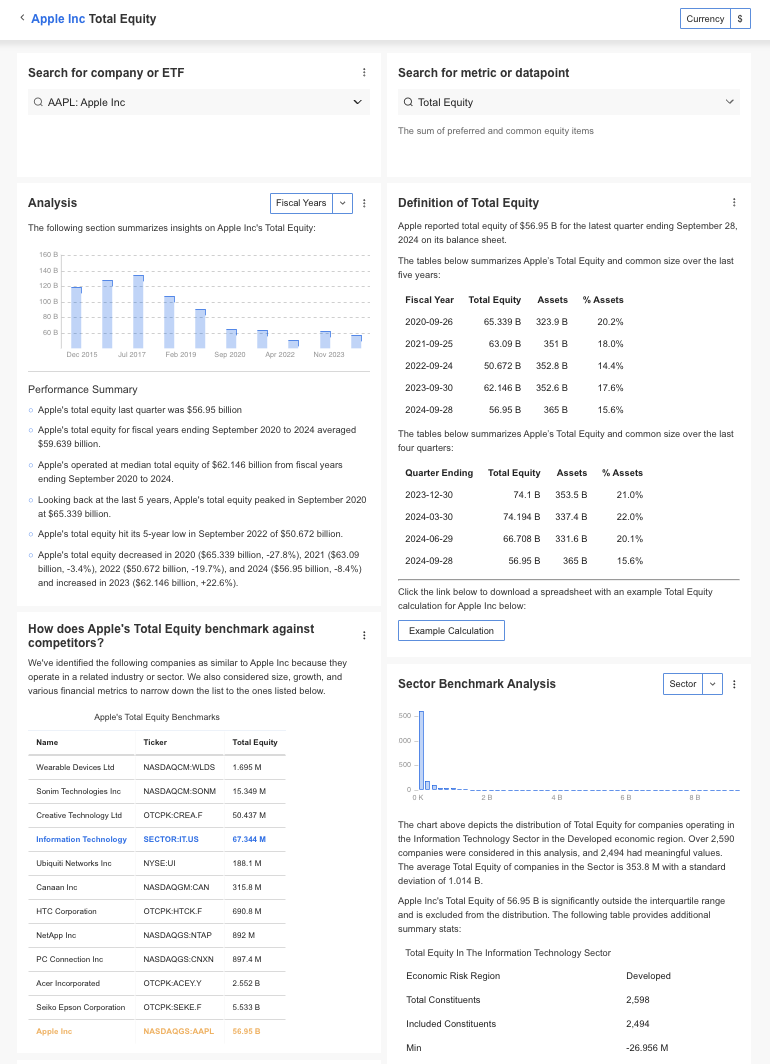
InvestingPro: Access Total Equity Data Instantly
Unlock Premium Data With InvestingPro 📈💸
Gain instant access to Total Equity data within the InvestingPro platform
🛠 Access to 1200+ additional fundamental metrics
🔍 Competitor comparison tools
📊 Evaluate stocks with 14+ proven financial models
Total Equity FAQ
Is total equity always a positive number?
No, total equity can be negative if a company’s liabilities exceed its assets. This situation, often called “negative equity,” may indicate financial trouble.
How does total equity differ from net income?
Total equity represents the cumulative value of ownership in a company, while net income refers to earnings generated during a specific period. Net income contributes to changes in total equity.
Can total equity fluctuate?
Yes, total equity can change due to various factors, including profits, losses, dividends, asset revaluation, or issuance/repurchase of shares.
How does total equity relate to the balance sheet?
Total equity is a key component of the balance sheet, appearing under the “Equity” section. It represents the difference between total assets and total liabilities.
What is the significance of treasury stock in total equity?
Treasury stock reduces total equity as it represents shares repurchased by the company, reducing the overall ownership interest.


 App Store
 Google Play